
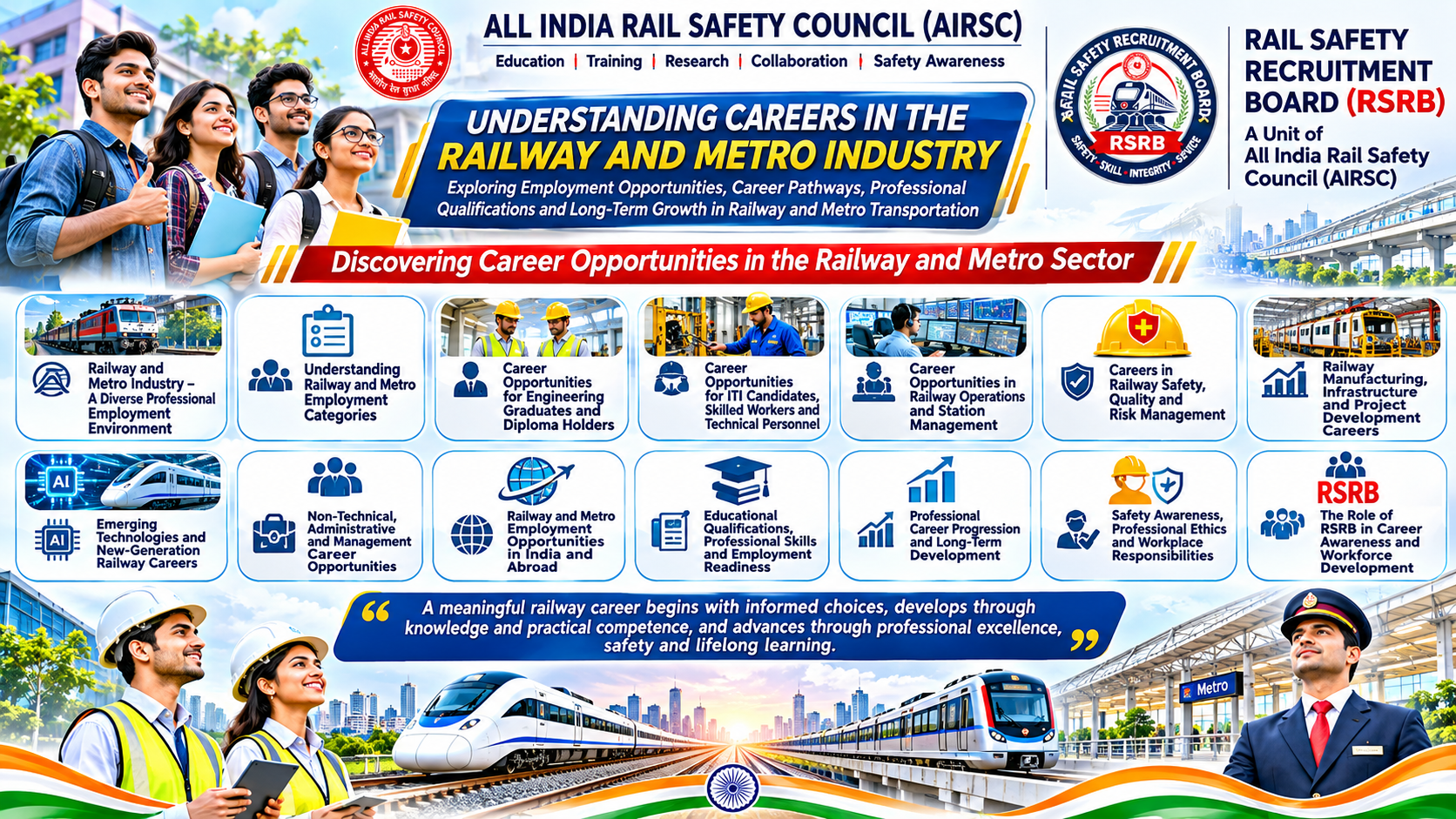
UNDERSTANDING CAREERS IN THE RAILWAY AND METRO INDUSTRY
Exploring Employment Opportunities, Career Pathways, Professional
Qualifications and Long-Term Growth in Railway and Metro Transportation
Introduction – Discovering Career
Opportunities in the Railway and Metro Sector
The railway and metro industry is one of the most important sectors of
modern transportation, offering a wide range of career opportunities across
engineering, technology, operations, infrastructure development, manufacturing,
maintenance, safety management and professional administration. As railway
networks expand, urban transportation systems develop and advanced technologies
become increasingly integrated into transportation infrastructure, the industry
requires qualified, skilled, responsible and safety-conscious professionals to
support its continued development. For students, graduates, technical diploma
holders, skilled workers and experienced professionals, understanding the
structure of the railway and metro industry is an essential first step towards
identifying suitable employment opportunities and building a meaningful,
sustainable and professionally rewarding career.
Railway and Metro Industry – A
Diverse Professional Employment Environment
The railway and metro industry extends far beyond the operation of
passenger trains and railway stations. It encompasses a comprehensive network
of technical, operational, commercial and administrative activities, including
railway infrastructure planning, track construction, civil engineering, rolling
stock manufacturing, electrical traction, signalling and telecommunications,
train control, passenger services, logistics, asset management, maintenance
engineering, information technology, safety assurance and project management.
Employment opportunities exist across government railway organisations,
public-sector undertakings, metro rail corporations, private engineering
companies, railway equipment manufacturers, infrastructure developers,
consulting organisations, technology providers and authorised service
contractors. Each organisation operates under its own recruitment procedures,
eligibility requirements and employment conditions, creating different
professional pathways for candidates with diverse qualifications and
experience.
Understanding Railway and Metro
Employment Categories
Railway and metro employment opportunities may be broadly classified
into engineering and technical services, train operations and traffic management,
infrastructure construction and maintenance, safety and quality assurance,
information and communication technology, administration and human resources,
commercial services, and management and leadership functions. Engineering and
technical positions focus on the design, installation, inspection, testing,
commissioning and maintenance of railway systems. Operational positions involve
the coordination and safe movement of trains, station operations, passenger
services and traffic management. Infrastructure-related positions support the
construction, inspection and maintenance of tracks, bridges, tunnels, stations,
depots and associated facilities. Administrative and professional positions
contribute to finance, procurement, human resources, legal services, contracts,
customer relations and organisational development. Understanding these
employment categories enables candidates to select appropriate career pathways
according to their educational background, technical interests, abilities and
long-term professional objectives.
Career Opportunities for Engineering
Graduates and Diploma Holders
Engineering graduates and diploma holders can explore professional
opportunities in civil engineering, mechanical engineering, electrical
engineering, electronics and communication engineering, instrumentation,
computer science, information technology and related technical disciplines.
Civil engineering professionals may pursue roles associated with railway track
infrastructure, bridges, tunnels, station construction, structural engineering
and project supervision. Mechanical engineering professionals may work in
rolling stock manufacturing, vehicle maintenance, mechanical systems, workshops
and equipment reliability. Electrical engineering professionals may specialise
in traction power supply, overhead electrification, substations, power
distribution and electrical maintenance. Electronics and telecommunications
professionals may explore signalling systems, train control, communications
networks, control centres and electronic safety systems. Computer science and
information technology graduates may pursue opportunities in railway software,
cybersecurity, data analytics, automation, passenger information systems and
digital infrastructure management. Entry into these roles depends on the
qualifications, competencies and experience specified by individual employers.
Career Opportunities for ITI
Candidates, Skilled Workers and Technical Personnel
Candidates with Industrial Training Institute qualifications, recognised
vocational training or relevant practical experience may explore opportunities
in railway workshops, equipment maintenance, electrical installations,
mechanical fitting, welding, fabrication, telecommunications support,
infrastructure maintenance and other skilled technical activities. Railway and
metro organisations require competent technicians and skilled personnel to
assist in maintaining the reliability, availability and operational readiness
of equipment and infrastructure. Such careers generally demand practical
technical knowledge, safe working practices, familiarity with tools and
equipment, and the ability to follow established maintenance procedures.
Candidates should carefully review the specific trade qualifications,
apprenticeship requirements, medical standards and competency conditions
prescribed for each position.
Career Opportunities in Railway
Operations and Station Management
Railway and metro operations provide important career pathways for
individuals interested in transportation management, operational coordination,
passenger services and service reliability. Depending on the organisation and
applicable recruitment rules, opportunities may arise in station operations,
traffic coordination, train operations, operations control centres, customer
assistance, timetable management, passenger information services and
operational supervision. These functions require strong communication skills,
situational awareness, procedural discipline, teamwork and the ability to
respond effectively to operational challenges. Certain operational positions
are safety-critical and require prescribed medical fitness, formal training,
competency assessment and employer authorisation before independent duties may
be performed.
Careers in Railway Safety, Quality
and Risk Management
Safety management is a fundamental professional discipline within the
railway and metro sector. Career opportunities may include safety engineering,
occupational health and safety, quality assurance, risk assessment, safety
auditing, incident investigation, emergency preparedness, systems assurance and
regulatory compliance. Professionals in these areas contribute to identifying
hazards, evaluating risks, improving operational procedures, monitoring safety
performance and supporting continuous improvement. Individuals interested in
these career pathways may benefit from relevant engineering or safety
qualifications, specialised training, knowledge of applicable safety standards
and practical experience in industrial or transportation environments. A
successful safety professional must demonstrate technical competence, impartial
judgement, ethical responsibility and a strong commitment to protecting
passengers, employees, assets and the public.
Railway Manufacturing, Infrastructure
and Project Development Careers
The railway manufacturing and infrastructure industries provide
employment opportunities in rolling stock production, railway component
manufacturing, track systems, signalling equipment, electrical systems,
engineering design, construction management, quality inspection, procurement
and supply-chain operations. Infrastructure projects require professionals in
project planning, surveying, construction supervision, testing and
commissioning, contract management, environmental management and technical
documentation. These career pathways are relevant to engineering graduates, diploma
holders, skilled technicians, project management professionals and experienced
industry specialists. Candidates may explore opportunities with railway
manufacturers, engineering contractors, original equipment manufacturers,
consulting firms, infrastructure developers and other organisations involved in
railway and metro projects.
Emerging Technologies and
New-Generation Railway Careers
Technological advancement is creating new professional opportunities
within the railway and metro industry. Artificial intelligence, automation,
digital signalling, communications-based train control, predictive maintenance,
Internet of Things applications, condition-monitoring technologies,
cybersecurity, digital twins and advanced data analytics are increasingly relevant
to modern transportation systems. These developments create potential career
pathways for software engineers, electronics specialists, systems engineers,
data analysts, cybersecurity professionals, automation engineers and
reliability specialists. Candidates preparing for future railway careers should
develop digital literacy, technical adaptability, analytical skills and an
understanding of how emerging technologies interact with established railway
safety and operational requirements.
Non-Technical, Administrative and
Management Career Opportunities
The railway and metro industry also provides career opportunities for
graduates and professionals from non-engineering backgrounds. Relevant areas
include human resource management, finance and accounting, procurement,
commercial administration, legal services, public relations, corporate
communications, logistics, supply-chain management, customer service,
documentation and organisational administration. These functions support the
effective management of railway organisations and infrastructure projects.
Graduates in commerce, business administration, economics, law, management,
humanities and related disciplines may explore suitable positions according to
the recruitment requirements of individual organisations. Professional
communication, computer proficiency, analytical ability, organisational skills
and ethical conduct are important competencies in these employment categories.
Railway and Metro Employment
Opportunities in India and Abroad
Railway and metro employment opportunities are not limited to a single
organisation or geographical region. In India, candidates may explore
recruitment opportunities through Indian Railways' authorised recruitment
mechanisms, eligible public-sector organisations, metro rail corporations,
railway-related manufacturing companies, engineering contractors and other
legitimate employers. Internationally, opportunities may arise through railway
operators, infrastructure developers, rolling stock manufacturers, technology
providers, engineering consultancies and maintenance organisations. Overseas
employment generally requires careful evaluation of professional
qualifications, experience, language requirements, work authorisation, visa
conditions, local regulations and employer-specific competency standards.
Candidates should verify all recruitment information directly through
authorised employer channels and exercise caution regarding unverified overseas
employment offers.
Educational Qualifications,
Professional Skills and Employment Readiness
Successful entry into the railway and metro industry requires an
informed understanding of the qualifications and skills associated with the
intended career pathway. Academic qualifications provide an important
foundation, but employers may also evaluate practical knowledge, technical
competence, communication ability, analytical thinking, teamwork,
problem-solving skills, professional discipline and safety awareness.
Candidates should strengthen their employability through relevant training,
recognised qualifications, practical projects, internships, apprenticeships
where available and continuous professional learning. Preparation for
recruitment should include understanding job descriptions, reviewing
eligibility conditions, improving subject knowledge, developing interview
skills and becoming familiar with legitimate assessment procedures.
Professional Career Progression and
Long-Term Development
A career in the railway and metro industry can provide opportunities for
progressive professional development through experience, specialised knowledge,
competency enhancement and leadership responsibilities. Depending on the
employer and career discipline, individuals may begin in trainee, junior
technical, engineering, operational or administrative roles and advance into
specialist, supervisory, managerial or senior professional positions. Career
growth is influenced by organisational policies, available vacancies,
qualifications, performance, practical experience and professional competence.
Continuing professional development, specialised certifications, technical
workshops, mentoring and exposure to multidisciplinary projects can support
long-term advancement and help professionals adapt to changing industry
requirements.
Safety Awareness, Professional Ethics
and Workplace Responsibilities
Every individual working within the railway and metro industry has a
responsibility to contribute to safe, reliable and responsible transportation
services. Technical expertise must be supported by professional integrity,
respect for established procedures, effective communication, accountability and
a willingness to report hazards or unsafe conditions. Employees should
understand the importance of safety management, operational discipline,
workplace conduct, occupational health, environmental responsibility and
cooperation between departments. In safety-critical roles, formal competence
and authorisation requirements must always take precedence over general
training certificates or informal experience. A professional commitment to
safety is not merely an employment expectation; it is an essential element of
public trust and organisational reliability.
The Role of RSRB in Career Awareness
and Workforce Development
The Rail Safety Recruitment Board (RSRB), a unit of the All India Rail
Safety Council (AIRSC), seeks to promote career awareness, professional
competency, responsible recruitment-related information and human resource
development within the railway, metro and allied transportation sectors.
Through career guidance, educational information, workforce-related knowledge
resources and constructive professional engagement, RSRB aims to assist
aspiring candidates in understanding employment categories, occupational
responsibilities, qualification requirements and evolving industry
expectations. The Board also recognises the importance of collaboration among
educational institutions, technical experts, training organisations and
industry stakeholders in strengthening employment readiness and supporting the
development of a competent and safety-conscious railway workforce.
Conclusion – Preparing for a
Meaningful Career in the Railway and Metro Industry
The railway and metro industry offers a broad and evolving professional
environment with opportunities for individuals from engineering, technical,
operational, administrative and management backgrounds. Building a successful
career requires more than identifying available positions; it involves
understanding industry requirements, selecting appropriate educational pathways,
developing practical skills, maintaining professional integrity and committing
to continuous learning. As transportation systems become more advanced,
integrated and technology-driven, professionals who combine technical
competence with adaptability, responsibility and safety awareness will be
better prepared to contribute to the future of railway and metro
transportation.
A meaningful railway career begins with informed choices, develops
through knowledge and practical competence, and advances through professional
excellence, safety and lifelong learning.
RAIL SAFETY RECRUITMENT BOARD (RSRB)
A Unit of All India Rail Safety Council (AIRSC)
Our Professional Commitment: Building a Skilled, Responsible
and Future-Ready Railway Workforce.
Website: www.railsafetyrecruitmentboard.com
RSRB is described here as a unit of the independent of AIRSC. It should be clearly distinguished from the Railway Recruitment Boards operating under India's Ministry of Railways. The article is general career guidance, not an announcement of vacancies or a guarantee of employment.