
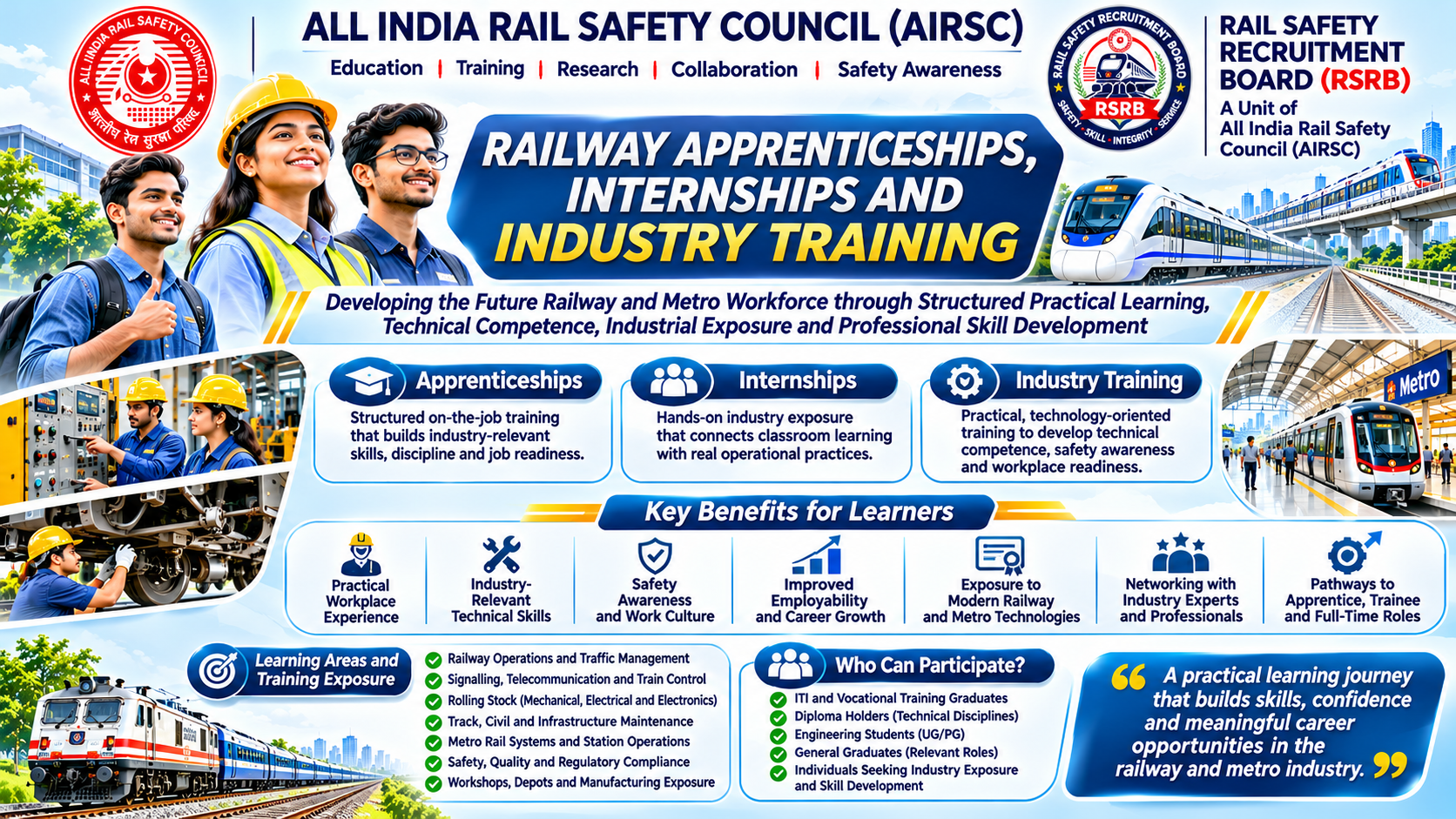
RAILWAY APPRENTICESHIPS, INTERNSHIPS AND INDUSTRY TRAINING
Developing the Future Railway and Metro Workforce through Structured
Practical Learning, Technical Competence, Industrial Exposure and Professional
Skill Development
Introduction – Connecting Academic
Education with Professional Railway Careers
The railway and metro industry is a highly specialised,
technology-driven and safety-critical sector that requires a competent
workforce equipped with theoretical knowledge, practical skills, professional
discipline and a strong understanding of operational safety. While academic
education provides the essential foundation for technical and professional
careers, structured workplace learning through apprenticeships, internships and
industry training enables aspiring professionals to understand how engineering
principles, operational procedures and safety requirements are applied in real
working environments. These learning opportunities help bridge the gap between
classroom education and industrial expectations, providing students, graduates,
diploma holders and vocational trainees with valuable exposure to railway
technologies, infrastructure systems, maintenance practices, engineering
processes and organisational responsibilities. As railway and metro systems
continue to modernise, practical training and industry-linked skill development
are becoming increasingly important components of professional career
preparation.
Understanding Railway Apprenticeships
and Their Professional Importance
Railway apprenticeships are structured training arrangements intended to
develop occupational knowledge, technical skills and workplace competence
through a combination of practical learning and, where applicable, theoretical
instruction. In India, apprenticeships may be conducted under the Apprentices
Act, 1961, and applicable rules, subject to the particular training scheme,
trade and employer. Apprenticeship opportunities may be available through
eligible railway establishments, production units, workshops, engineering
organisations, manufacturing companies and other participating employers.
Depending on the notified programme, apprentices may receive supervised
exposure to mechanical maintenance, electrical systems, fitting, welding,
machining, electronics, equipment inspection, workshop procedures and related
technical activities. Apprenticeships should be understood primarily as
structured training opportunities rather than automatic pathways to permanent
employment. Completion of an apprenticeship does not, by itself, guarantee
appointment to Indian Railways, a metro corporation or any other organisation.
Internships – Practical Exposure for
Students and Graduates
Internships provide students and graduates with opportunities to
observe, study and, where authorised, participate in professional activities within
railway and metro-related organisations. These programmes may be offered by
engineering companies, infrastructure developers, rolling stock manufacturers,
technology providers, research institutions, consulting organisations and
certain railway or metro establishments, depending on their policies and
available programmes. Internships may involve engineering documentation,
technical studies, design support, data analysis, project coordination, quality
processes, maintenance planning or supervised site observations. Unlike formal
apprenticeships, internships vary considerably in duration, structure,
eligibility, remuneration and certification. Students should review the
specific terms of each programme, including supervision arrangements, permitted
activities, confidentiality obligations, workplace safety requirements and
expected learning outcomes.
Industry Training – Developing
Practical Technical Competence
Industry training is an important means of strengthening the
relationship between academic knowledge and the practical requirements of
railway and metro operations. Structured industrial training may introduce
participants to railway infrastructure, track engineering, signalling and
telecommunications, rolling stock systems, electrical traction, construction
management, maintenance planning, quality assurance and safety management.
Training may include technical demonstrations, supervised workshops, laboratory
exercises, equipment familiarisation, maintenance observations, project
assignments and assessments. Effective programmes establish clear learning
objectives, competent supervision, appropriate safety controls and documented
outcomes. Industry training can improve professional readiness, but
participation in a short course or industrial visit should not be represented
as qualification or authorisation to perform safety-critical railway duties
independently.
Apprenticeship Opportunities for ITI
and Vocationally Qualified Candidates
Candidates holding relevant Industrial Training Institute qualifications
or other recognised vocational credentials may explore apprenticeship
opportunities in technical trades associated with railway and metro systems.
Depending on employer requirements and notified eligibility, these may include
fitter, electrician, welder, machinist, mechanic, electronics mechanic and
other applicable trades. Apprentices may gain practical familiarity with
workshop discipline, equipment handling, preventive maintenance, inspection
procedures, technical drawings, measuring instruments, safe use of tools and
workplace coordination. The purpose of such training is to develop sound
technical foundations and responsible working habits under appropriate
supervision. Candidates should verify trade eligibility, age conditions,
selection procedures, training duration, stipend provisions and certification
arrangements directly from official notifications.
Practical Learning Opportunities for
Engineering and Diploma Students
Engineering and diploma students may benefit from industrial training
relevant to civil, mechanical, electrical, electronics, instrumentation,
telecommunications, computer science and related disciplines. Civil engineering
trainees may study railway track structures, bridges, tunnels, stations,
surveying, construction planning and quality control. Mechanical engineering
trainees may gain exposure to rolling stock components, workshop practices,
maintenance systems and equipment reliability. Electrical engineering trainees
may learn about traction power, substations, overhead equipment, electrical
protection and energy management. Electronics and telecommunications trainees
may study signalling concepts, train control interfaces, communications
networks and electronic equipment. Computer science and information technology
students may explore railway software applications, cybersecurity, data
analytics, automation and digital monitoring. Actual access to railway
installations, technical systems and operational facilities must always be
subject to organisational permission, supervision and safety requirements.
Training in Railway Operations,
Maintenance and Infrastructure Systems
Railway and metro industry training can provide valuable insight into
the coordinated activities required to operate and maintain complex
transportation systems. Participants may be introduced to the functions of
stations, depots, workshops, operations control centres, maintenance teams and
infrastructure departments through approved learning arrangements. Training
topics may include maintenance planning, asset inspection, operational
communication, documentation, quality assurance, technical coordination and the
importance of following established procedures. Such exposure helps learners
understand the relationship between individual technical activities and the
wider railway system. However, observing operational practices or completing
familiarisation training does not confer authority to operate trains, control
signalling equipment, undertake independent maintenance or perform other
safety-critical functions.
Safety Awareness and Professional
Responsibility During Industrial Training
Safety is the foundation of every legitimate railway and metro training
activity. Apprentices, interns and trainees must understand that railway
environments may involve moving trains, high-voltage electrical equipment,
machinery, lifting operations, working at height, restricted areas and other
significant hazards. Training organisations and host employers should establish
suitable induction programmes, risk assessments, supervision arrangements,
access controls, emergency procedures and personal protective equipment
requirements where applicable. Trainees must follow authorised instructions,
respect restricted areas, report unsafe conditions and avoid undertaking tasks
beyond their competence or permission. A responsible training programme
develops not only technical ability but also the professional discipline,
hazard awareness and accountability necessary for working in safety-sensitive
industries.
Competency-Based Learning and
Assessment
Effective apprenticeship and industrial training programmes should be
designed around clearly defined learning outcomes rather than attendance alone.
Competency-based learning may combine technical instruction, supervised
practical activities, workplace observations, assignments, progress reviews and
appropriate assessments. Depending on the programme, trainees may be evaluated
on technical understanding, practical workmanship, safety awareness,
documentation, communication, teamwork and adherence to procedures. Training
records, supervisor feedback and verified competency achievements can help
learners identify their strengths and areas requiring further development.
Nevertheless, programme completion certificates and training assessments must
be distinguished from statutory licences, employer authorisations and formal competency
certification required for particular railway duties.
Industry–Academia Collaboration and
Professional Skill Development
Collaboration between educational institutions and railway-related
industries can strengthen the quality and relevance of practical training.
Engineering colleges, polytechnic institutions, ITIs, universities, skill
development organisations and industry employers may work together to identify
occupational skill requirements, develop practical learning modules, arrange
authorised internships and support technical mentoring. Such partnerships can
help educational institutions align learning outcomes with evolving industry
practices while giving students greater awareness of workplace expectations.
Industry representatives may contribute through guest lectures, technical
demonstrations, project guidance, curriculum consultation and supervised
industrial exposure. Successful collaboration requires clearly defined
responsibilities, transparent selection processes, appropriate safeguarding
measures and realistic communication regarding employment outcomes.
Emerging Technologies and
Future-Oriented Industrial Training
Modern railway and metro systems increasingly incorporate digital
technologies, advanced automation, intelligent monitoring and data-driven
maintenance practices. Future-oriented training may therefore introduce
learners to digital signalling, communications-based train control, predictive
maintenance, sensor technologies, artificial intelligence applications,
cybersecurity, systems engineering, digital twins and sustainable
transportation systems. Training should explain not only the potential benefits
of these technologies but also their limitations, operational interfaces and
safety implications. Students with an interest in emerging technologies may
strengthen their career readiness by developing relevant programming,
electronics, analytical, engineering and systems-integration skills. Practical
exposure should remain appropriately supervised, particularly where digital systems
interact with safety-critical railway functions.
Professional Skills, Workplace
Discipline and Employability
Apprenticeships and internships can help learners develop essential
professional qualities beyond technical knowledge. These include punctuality,
communication, teamwork, problem-solving, professional ethics, documentation,
time management, adaptability and respect for workplace procedures. Industrial
environments require individuals to cooperate with supervisors, engineers,
technicians, safety personnel and administrative teams while maintaining
professional conduct. Trainees who demonstrate initiative, willingness to
learn, attention to detail and responsible behaviour can gain a clearer
understanding of employer expectations. Although practical training may improve
employability, recruitment decisions remain subject to vacancies,
qualifications, selection criteria, organisational policies and applicable
laws.
Understanding Training Duration,
Stipends and Certification
The duration, financial arrangements and certification of
apprenticeships, internships and industrial training programmes depend on the
applicable scheme, employer and training category. Formal apprenticeships may
be governed by statutory provisions and notified programme conditions,
including training periods, stipend requirements and assessment or
certification arrangements. Internships may be paid or unpaid where legally
permissible and may range from short academic placements to longer structured
assignments. Industry training programmes may also differ in duration,
supervision and assessment methods. Candidates should obtain written
information on programme eligibility, fees if any, stipends, insurance or
safety arrangements, attendance expectations, completion requirements and the
nature of the certificate awarded. No training provider should imply that a
participation certificate automatically grants employment eligibility, a
statutory qualification or authority to perform safety-critical duties.
How to Identify Genuine Railway Apprenticeship
and Internship Opportunities
Candidates should rely on official recruitment and training
notifications issued by authorised railway establishments, metro organisations,
educational institutions and legitimate industry employers. In India, relevant
apprenticeship information may be available through government apprenticeship
portals and official employer websites, depending on the training category.
Applicants should carefully verify the name of the organisation, eligibility
criteria, selection procedure, application deadline, training location, stipend
conditions and contact details before submitting personal information or
payments. Unverified advertisements, promises of guaranteed railway employment
and requests for unofficial recruitment fees should be treated with caution. A
legitimate training opportunity should clearly explain its educational purpose,
selection process, supervision arrangements and whether any employment
opportunity exists separately from the training programme.
Career Development After
Apprenticeships and Industrial Training
Completion of an apprenticeship, internship or industrial training
programme can provide a useful foundation for future education, technical
specialisation and employment preparation. Trainees may use their experience to
strengthen technical portfolios, improve resumes, prepare for interviews and
identify suitable professional pathways. Some individuals may pursue additional
qualifications, specialised certifications or advanced training in railway engineering,
maintenance, safety management, signalling, telecommunications, project
management or digital technologies. Others may apply for suitable positions
with railway-related employers when vacancies are advertised. Career
advancement depends on demonstrated competence, relevant qualifications,
practical experience and successful completion of applicable recruitment
procedures. Training should therefore be regarded as an important stage of
professional development rather than a substitute for formal recruitment.
The Role of RSRB in Promoting
Practical Learning and Workforce Readiness
The Rail Safety Recruitment Board (RSRB), a unit of the All India Rail
Safety Council (AIRSC), recognises the importance of structured practical
learning, industry awareness and professional competency development in
preparing aspiring candidates for railway and metro careers. Through career
information, educational guidance, skill-development awareness and
workforce-related knowledge sharing, RSRB seeks to help students, graduates,
diploma holders and vocational trainees understand the value of
apprenticeships, internships and industry training. The Board encourages
responsible engagement among educational institutions, training organisations,
industry professionals and employers to support better awareness of
occupational requirements, workplace expectations and professional development
pathways. Such initiatives should promote transparent information, appropriate
supervision, recognised training arrangements and a clear distinction between
learning opportunities and formal employment.
Conclusion – Transforming Learning
into Professional Competence
Railway apprenticeships, internships and industry training provide
valuable opportunities for aspiring professionals to connect academic education
with the practical realities of modern transportation systems. Through
structured learning, supervised industrial exposure, technical skill
development and responsible workplace participation, trainees can strengthen
their professional understanding and prepare more effectively for future career
opportunities. The long-term value of practical training lies not only in
acquiring technical knowledge but also in developing safety awareness,
professional discipline, ethical responsibility, adaptability and a commitment
to continuous improvement. As railway and metro technologies continue to
advance, meaningful cooperation between education and industry will remain
essential for developing a skilled, competent and future-ready workforce
capable of supporting safe, reliable and sustainable transportation.
A successful railway career is built not merely through academic
qualifications, but through the effective combination of knowledge, supervised
practical experience, professional competence, safety awareness and lifelong
learning.
OUR PROFESSIONAL MESSAGE
“Learn with Purpose, Train with Discipline, Develop with Competence, and
Build Your Railway Career with Safety and Professional Excellence.”
RAIL SAFETY RECRUITMENT BOARD (RSRB)
A Unit of All India Rail Safety Council (AIRSC)
Building the Future Railway Workforce through Knowledge, Practical
Skills, Safety and Professional Excellence.
Website: www.railsafetyrecruitmentboard.com
Important Career Information Notice: This article is intended for general educational and career guidance. RSRB is a unit of AIRSC, an independent organisation, and is distinct from the official Railway Recruitment Boards under the Ministry of Railways. Apprenticeships, internships and industry training do not automatically guarantee employment in Indian Railways, metro corporations or other organisations. Candidates must verify all opportunities, qualifications, training conditions and recruitment procedures through the relevant authorised organisations.