
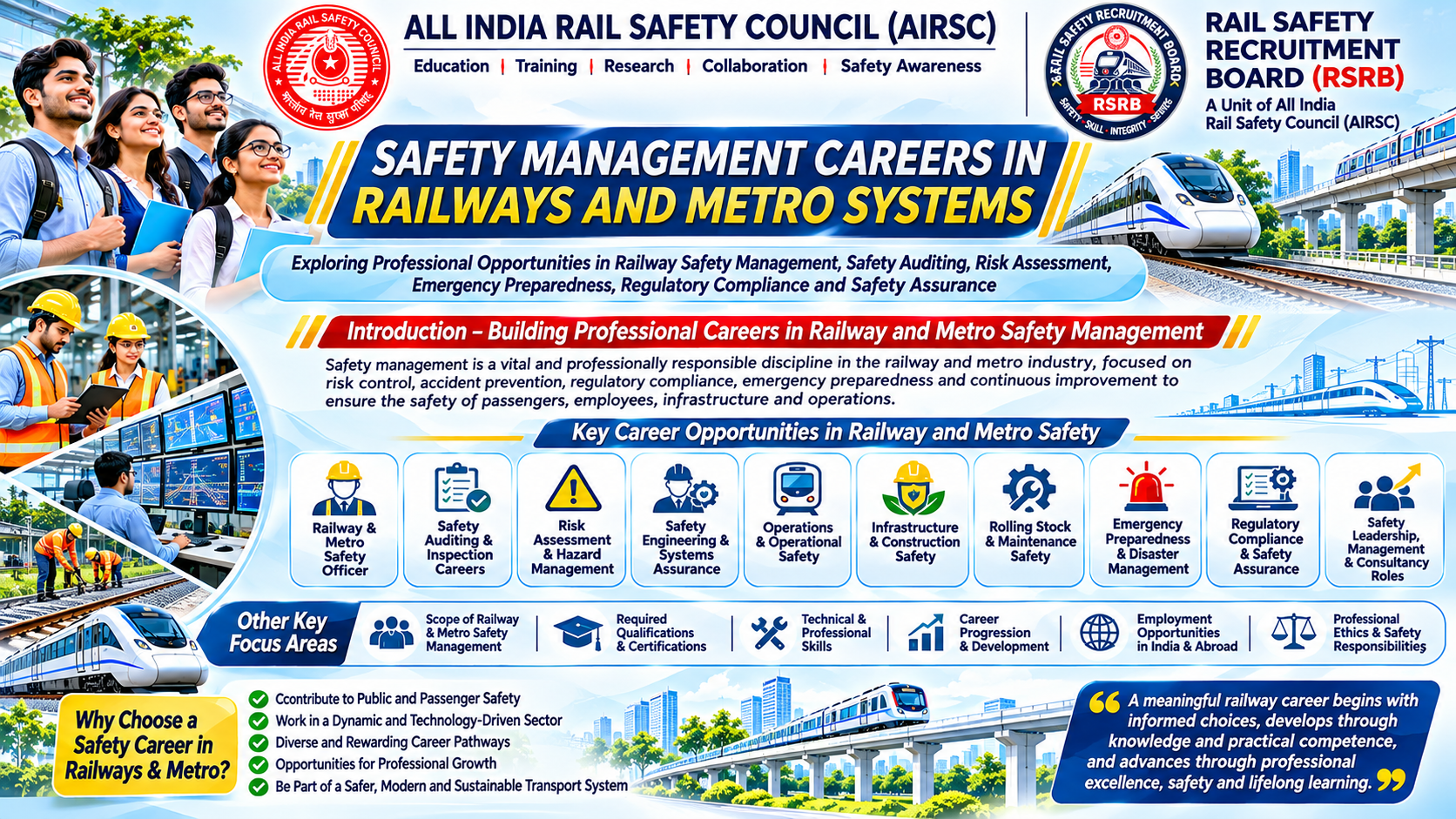
SAFETY
MANAGEMENT CAREERS IN RAILWAYS AND METRO SYSTEMS
Exploring Professional Opportunities in Railway Safety Management,
Safety Auditing, Risk Assessment, Emergency Preparedness, Regulatory Compliance
and Safety Assurance
Introduction – Building Professional
Careers in Railway and Metro Safety Management
Safety management is one of the most essential and professionally
responsible disciplines within the railway and metro transportation industry.
As railway networks expand, metro systems become increasingly sophisticated and
transportation technologies continue to evolve, the need for qualified safety
professionals remains fundamental to protecting passengers, employees,
infrastructure, operational assets and the wider public. Railway and metro
safety management encompasses the systematic identification of hazards,
assessment and control of risks, prevention of accidents, monitoring of safety
performance, preparation for emergencies and continuous improvement of
operational practices. For engineering graduates, technical professionals,
experienced railway employees and individuals pursuing careers in safety
engineering, occupational safety and risk management, this specialised field
offers diverse opportunities to contribute to the reliability, resilience and
responsible development of modern transportation systems.
Understanding the Scope of Railway
and Metro Safety Management
Railway and metro safety management extends beyond routine inspections
and compliance checks. It involves an integrated approach to identifying
operational, technical, organisational and human-factor risks throughout the
lifecycle of railway systems. Safety management activities may include
infrastructure safety, train operations, signalling and train control, rolling
stock maintenance, electrical systems, station and passenger safety,
construction activities, occupational health, fire prevention, emergency
preparedness, contractor safety and organisational safety assurance. Effective
safety management requires close cooperation among engineering departments,
operations personnel, maintenance teams, contractors, management
representatives and regulatory stakeholders. Professionals in this field must
understand how different railway systems interact and how failures, unsafe
conditions or inadequate procedures may affect overall transportation safety.
Career Opportunities for Railway and
Metro Safety Officers
Safety Officers play an important role in promoting safe working
environments, monitoring operational practices, identifying workplace hazards
and supporting the implementation of organisational safety policies. Depending
on the employer and job description, their responsibilities may include
conducting workplace inspections, reviewing safe working procedures, monitoring
the use of protective equipment, coordinating safety awareness programmes,
participating in incident investigations and supporting corrective and
preventive actions. In railway and metro environments, Safety Officers may be
associated with depots, workshops, construction sites, stations, maintenance
facilities, infrastructure projects and operational support activities.
Candidates seeking these positions may benefit from qualifications in
engineering, industrial safety, occupational health and safety or related
disciplines, together with practical knowledge of railway operations and
applicable safety requirements. Some positions may require specific statutory
qualifications, certifications or relevant professional experience.
Professional Careers in Railway
Safety Auditing and Inspection
Safety Auditors and Inspection Professionals contribute to the
systematic evaluation of safety management systems, operational procedures,
technical controls and organisational compliance. Their work may involve
examining safety documentation, reviewing maintenance and inspection records,
assessing the effectiveness of risk controls, evaluating training and
competency arrangements, identifying nonconformities and recommending
improvements. Railway and metro safety audits may address infrastructure,
rolling stock, signalling interfaces, electrical installations, occupational
safety, emergency preparedness and organisational safety processes. Effective
auditors require technical understanding, evidence-based assessment skills,
professional independence, clear reporting ability and familiarity with
applicable standards and audit methodologies. Career progression may lead
towards specialist auditor, lead auditor, safety assurance manager or
independent assessment roles, subject to the required competence, independence
and authorisation.
Career Pathways in Railway Risk
Assessment and Hazard Management
Risk Assessment Specialists and Hazard Management Professionals focus on
identifying potential sources of harm, analysing their consequences and
supporting the development of appropriate risk-control measures. Railway risk
management may involve hazard identification workshops, risk registers, safety
studies, failure analysis, interface risk assessments, operational risk reviews
and the evaluation of proposed engineering or organisational changes.
Professionals may apply methodologies such as Hazard Identification (HAZID),
Failure Modes and Effects Analysis (FMEA), Fault Tree Analysis (FTA), risk
matrices and other suitable techniques according to the nature of the system
and applicable requirements. These positions are particularly relevant to
engineers and technical specialists with strong analytical capabilities,
systems thinking, knowledge of safety engineering principles and experience in
complex transportation or industrial environments. The objective is not merely
to document risks but to support effective decisions that reduce risk to an
acceptable level under applicable safety requirements.
Railway Safety Engineering and
Systems Assurance Careers
Safety Engineers and Systems Assurance Professionals are involved in
evaluating whether railway infrastructure, equipment and integrated systems
meet specified safety requirements throughout their development and operational
lifecycle. Their responsibilities may include safety planning, hazard analysis,
safety requirements management, design reviews, verification and validation,
safety case development, interface assessment and management of safety-related
changes. These activities are particularly relevant to signalling systems,
train control technologies, rolling stock, platform systems, electrical
infrastructure and integrated metro operations. Professionals working in these
areas may require knowledge of systems engineering, reliability engineering,
functional safety and railway-specific standards, including the EN 50126, EN
50128 and EN 50129 framework where applicable, together with its relevant
successor standards and current project requirements. Strong technical documentation,
analytical judgement and multidisciplinary coordination skills are important
for career development in this field.
Emergency Planning, Disaster
Preparedness and Crisis Management Careers
Emergency Planning and Disaster Management Professionals contribute to
preparing railway and metro organisations for incidents that may disrupt
operations or threaten public safety. Their responsibilities may include
developing emergency response plans, coordinating evacuation procedures,
conducting emergency drills, assessing response capabilities, supporting fire
and life-safety preparedness and establishing communication arrangements with
emergency services. Railway emergencies may involve train accidents, fires,
electrical hazards, infrastructure failures, hazardous material incidents,
extreme weather events, flooding, security-related disruptions and other
operational emergencies. In metro systems, underground stations, tunnels, high
passenger density and restricted access conditions may create additional emergency
planning challenges. Professionals in this area require strong organisational
abilities, risk awareness, emergency coordination skills, knowledge of relevant
procedures and the capacity to work effectively with multiple agencies under
demanding circumstances.
Regulatory Compliance, Safety
Governance and Standards Management
Regulatory Compliance and Safety Governance Professionals support
organisations in understanding and meeting applicable legal, technical and
institutional safety obligations. Their work may include maintaining compliance
registers, reviewing safety procedures, monitoring regulatory developments,
coordinating statutory inspections, preparing compliance documentation and
supporting management reviews. In India, relevant requirements may arise from
railway legislation, metro railway legislation, rules, technical standards,
statutory directions and the requirements of competent authorities, depending
on the organisation and system concerned. Professionals must distinguish
between statutory obligations, applicable technical standards, contractual
requirements and internal organisational policies. Successful compliance
specialists require strong documentation skills, regulatory awareness,
attention to detail, professional integrity and the ability to communicate
requirements clearly to technical and management teams.
Occupational Health, Workplace Safety
and Employee Welfare Careers
Occupational Health and Safety Professionals focus on preventing
work-related injuries, illnesses and unsafe conditions affecting railway and
metro employees, contractors and maintenance personnel. Their responsibilities
may include workplace hazard assessments, safe systems of work, electrical
safety, working at height, confined-space safety, lifting operations, machinery
safety, fire prevention, contractor management and occupational health
programmes. Railway depots, workshops, construction sites and maintenance
facilities present varied workplace hazards requiring competent assessment and
preventive controls. Professionals in this field may work as Occupational
Safety Officers, Health and Safety Coordinators, Safety Managers, Construction
Safety Specialists or Contractor Safety Advisors. Knowledge of applicable
occupational safety legislation, ISO 45001 principles, risk assessment methods
and practical workplace safety management can support professional development.
Railway Incident Investigation and
Safety Performance Analysis
Incident Investigation and Safety Performance Professionals contribute
to understanding the circumstances, contributing factors and underlying
organisational conditions associated with accidents, near misses and unsafe
events. Their responsibilities may include collecting and preserving relevant
evidence, reviewing technical and operational records, interviewing involved
personnel, analysing causal factors and recommending corrective and preventive
actions. Effective investigations seek to identify opportunities for systemic
improvement rather than relying solely on individual blame. Safety performance
specialists may also analyse incident trends, hazard reports, inspection
findings, audit results and leading and lagging safety indicators to identify
emerging risks and assess the effectiveness of safety controls. These roles
require analytical ability, impartiality, confidentiality, sound technical
judgement and clear professional reporting.
Safety Management Systems and
Organisational Safety Culture
Safety Management System (SMS) Professionals support the establishment,
implementation, monitoring and continual improvement of structured safety
management arrangements. Their work may involve developing safety policies,
assigning responsibilities, maintaining hazard and risk management processes,
coordinating safety assurance activities, monitoring safety performance,
supporting management of change and promoting organisational learning. A mature
safety management approach integrates leadership commitment, employee
participation, competency management, contractor oversight, reporting
arrangements and continuous improvement. Safety culture specialists may also
contribute to behavioural safety programmes, leadership engagement, employee
communication and the development of a workplace environment in which hazards
and concerns can be reported responsibly. These careers combine technical
safety knowledge with organisational management, communication and leadership
skills.
Educational Qualifications and
Professional Competencies
Educational and professional requirements for railway and metro safety
careers vary according to the employer, job category and level of
responsibility. Relevant backgrounds may include civil, mechanical, electrical,
electronics, instrumentation and systems engineering, as well as occupational
health and safety, industrial safety, fire safety, emergency management and
related technical disciplines. Some roles may be accessible through suitable
diploma qualifications and experience, while specialist safety engineering and
assurance positions may require advanced technical knowledge and substantial
project experience. Relevant professional learning may include hazard
identification, risk assessment, incident investigation, safety auditing,
functional safety, reliability engineering, emergency management and safety
management systems. Candidates should verify whether particular qualifications,
certifications, experience or statutory approvals are mandatory for the
position they intend to pursue.
Essential Professional Skills for
Safety Management Careers
A successful safety professional must possess more than theoretical
knowledge of safety regulations and procedures. Important competencies include
hazard recognition, analytical reasoning, systems thinking, risk-based
decision-making, technical documentation, evidence evaluation, communication,
teamwork, professional independence and ethical judgement. Railway and metro
safety professionals frequently work with multidisciplinary teams and must be
capable of understanding technical interfaces between infrastructure, rolling
stock, signalling, electrical systems, operations and maintenance. They must
also demonstrate the confidence to raise legitimate safety concerns, the
discipline to follow established procedures and the ability to communicate
complex safety information in a clear and practical manner. Continuous learning
is particularly important because technologies, operating practices, standards
and organisational requirements change over time.
Employment Opportunities Across
Railway and Metro Organisations
Safety management professionals may explore opportunities with railway
operators, metro rail corporations, infrastructure developers, engineering and
construction contractors, rolling stock manufacturers, signalling and
telecommunications companies, maintenance service providers, engineering
consultancies, technical assessment organisations and industrial safety service
providers. Opportunities may arise during project planning, construction,
testing, commissioning, operations, maintenance, modernisation and system
renewal. Job titles and responsibilities differ across employers, and
candidates should carefully review the scope of each position. Railway-specific
operational safety roles may require experience and competence beyond general
occupational health and safety qualifications, while specialist assessment
positions may require demonstrable independence and relevant technical
expertise.
Emerging Safety Technologies and
Future Professional Opportunities
The increasing use of digital technologies is influencing the future of
railway and metro safety management. Predictive maintenance systems, remote
condition monitoring, advanced sensor networks, digital inspection platforms,
data analytics, artificial intelligence and cybersecurity-related risk
management are creating new areas of professional specialisation. Safety
professionals may increasingly be required to understand the interaction
between software, hardware, human operators and organisational processes.
However, the use of advanced technology does not remove the need for
engineering judgement, independent verification, documented safety evidence and
competent human oversight. Professionals who combine traditional safety
engineering knowledge with digital skills, systems assurance and risk
management capabilities may be well positioned to contribute to emerging
industry requirements.
Professional Career Development and
Leadership Opportunities
Railway and metro safety management offers pathways for progressive
professional development, depending on qualifications, experience, performance
and organisational requirements. Individuals may begin in safety coordination,
junior engineering, inspection, technical support or related positions and
subsequently develop expertise in auditing, hazard management, emergency
planning, systems assurance or safety governance. With suitable experience and
competence, professionals may advance towards Senior Safety Officer, Safety
Engineer, Lead Auditor, Risk Manager, Safety Assurance Manager, Head of Safety
or other leadership responsibilities. Long-term career growth requires
continued technical learning, practical experience, recognised professional
development and the ability to demonstrate sound safety judgement. Leadership
positions also demand effective communication, organisational awareness,
integrity and the capacity to influence safety improvements across departments.
The Role of RSRB in Promoting Safety
Career Awareness
The Rail Safety Recruitment Board (RSRB), a unit of the All India Rail
Safety Council (AIRSC), recognises the importance of developing professionally
competent, safety-conscious and responsible human resources for railway and
metro transportation systems. Through career information, competency awareness,
educational guidance and workforce-related knowledge sharing, RSRB seeks to
help aspiring professionals understand the responsibilities, qualifications,
skills and professional expectations associated with safety management careers.
The Board encourages candidates to pursue appropriate education, practical
learning, recognised professional development and responsible employment
practices while appreciating the critical importance of safety in railway
operations and infrastructure development.
Conclusion – Developing the Next
Generation of Railway Safety Professionals
Safety management careers in railway and metro systems offer meaningful
professional opportunities for individuals committed to protecting human life,
preventing accidents, improving organisational performance and strengthening
public confidence in transportation services. The sector requires professionals
who can combine technical expertise with ethical responsibility, analytical
thinking, operational understanding and a continuous commitment to learning. As
railway and metro systems become more advanced and interconnected, competent
safety officers, auditors, engineers, risk specialists, emergency planners and
compliance professionals will continue to play essential roles in supporting safe
and reliable operations. A career in railway safety management is therefore not
simply an occupational choice; it is an opportunity to contribute directly to
responsible infrastructure development, operational excellence and the
protection of passengers, employees and communities.
The true measure of professional excellence in railway safety lies not only in identifying risks, but in applying knowledge, competence and responsible action to prevent harm and strengthen the safety of every journey.
OUR PROFESSIONAL MESSAGE
“Safety Is a Professional Responsibility, Competence Is Its Foundation,
and Continuous Improvement Is the Path to Safer Railways and Metro Systems.”
RAIL SAFETY RECRUITMENT BOARD (RSRB)
A Unit of All India Rail Safety Council (AIRSC)
Building the Future Railway Workforce through Safety, Knowledge,
Competence and Professional Excellence.
Website: www.railsafetyrecruitmentboard.com
This article provides general professional and career information. RSRB, as a unit of the independent of AIRSC, should be distinguished from statutory railway safety authorities and official government recruitment bodies. All job opportunities, eligibility conditions and professional authorisations must be verified with the relevant employer or competent authority.